IPTV Player P2P
Discover how WebRTC peer-to-peer (P2P) streaming reshapes IPTV delivery. Learn the mechanics, architecture, and impact of distributed video delivery that reduces server bandwidth by 70% using pure browser-based WebRTC technology.
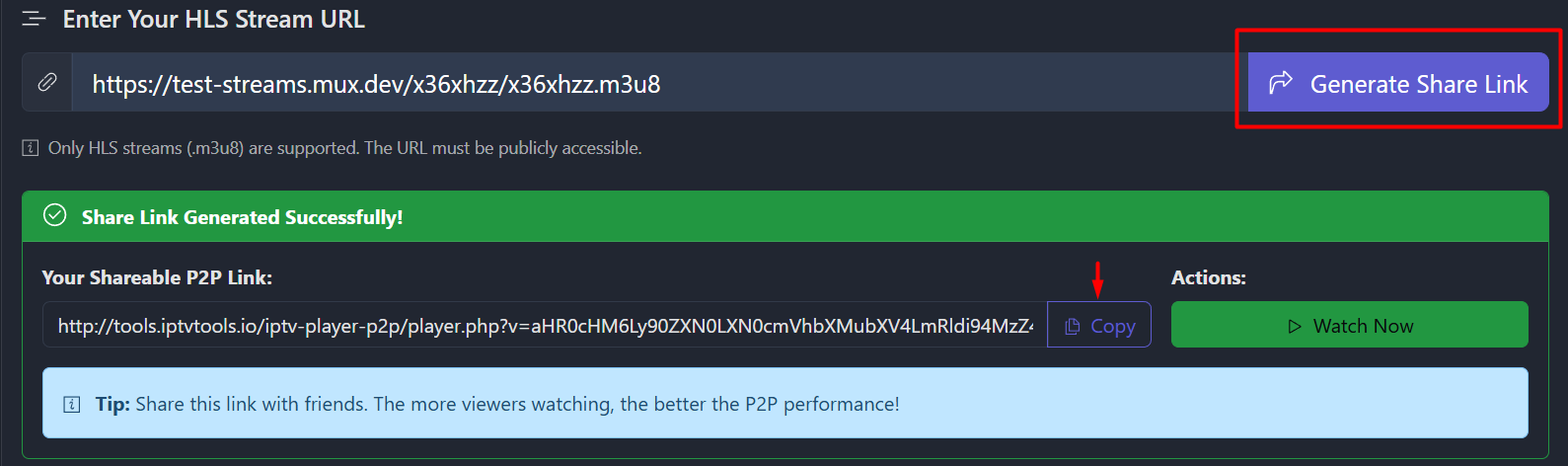
🎯 What is Peer-to-Peer (P2P) Streaming?
P2P streaming is a distributed delivery method where viewers not only consume video data but also share parts of it with other users. Instead of every viewer downloading the full stream from the origin server, segments are exchanged directly between peers using WebRTC, a browser-native communication protocol.
This approach drastically reduces server bandwidth consumption and enhances reliability, especially during traffic spikes or live events.
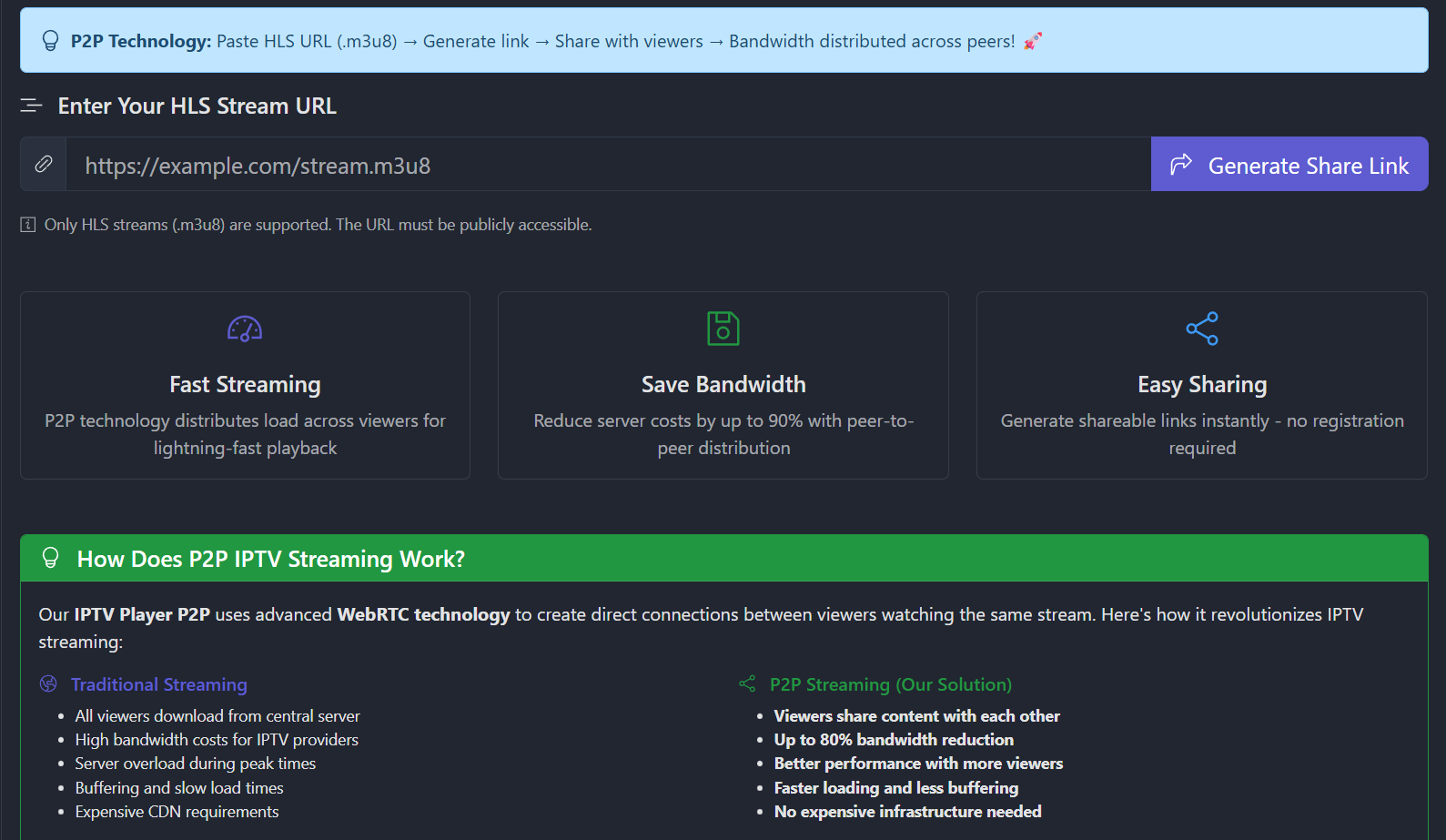

P2P 🧠 The Mesh Network Concept
⚙️ How P2P Protocol Works
At its core, P2P streaming relies on three essential components:
- WebRTC (Web Real-Time Communication) – Enables direct peer-to-peer connections between browsers without intermediate servers.
- STUN/TURN/ICE servers – Facilitate network traversal and establish communication even when peers are behind NATs or firewalls.
- Segment-based video exchange – Each viewer downloads and stores small video segments that can be uploaded to others in real time.
🔍 Step-by-Step Process
1️⃣ Viewer 1 joins stream → downloads full video segments from origin.
2️⃣ Viewer 2 joins → requests missing segments from Viewer 1 via WebRTC.
3️⃣ Viewer 3 joins → connects to both previous peers.
4️⃣ A mesh network forms → all viewers share segments collaboratively.
Each new viewer increases efficiency instead of adding load — the opposite of traditional CDN behavior.
🌐 The Role of WebRTC in P2P Streaming
WebRTC is a real-time communication framework built into every major browser. It uses data channels to send binary video chunks directly between users.
🧩 Core Mechanisms
| Component | Description |
|---|---|
| ICE (Interactive Connectivity Establishment) | Chooses the fastest connection path between peers. |
| STUN (Session Traversal Utilities for NAT) | Finds public IP and port to establish communication. |
| TURN (Traversal Using Relays around NAT) | Relays traffic when direct peer connection is impossible. |
| DTLS + SRTP Encryption | Secures audio/video and data transmission. |
⚡ Advantages
- Zero plugin or software installation
- Real-time, encrypted peer communication
- Works directly in Chrome, Firefox, Edge, and Opera
- No central streaming servers required
🧠 The Mesh Network Concept
A mesh network forms dynamically when multiple viewers are watching the same stream. Each peer becomes a micro-node that receives and redistributes video segments to others.
Diagram Representation
Origin Server
    ↓
 Viewer 1 (Seed)
   ↙   ↘
Viewer 2 ↔ Viewer 3 ↔ Viewer 4
   ↘     ↙     ↘
  Viewer 5 ↔ Viewer 6 ↔ Viewer 7
As the swarm grows, bandwidth distribution becomes more balanced, and origin load decreases.
Benefits of a Mesh-Based Architecture
- 🔁 Load balancing: traffic distributed between viewers.
- 🚀 Faster buffering: simultaneous downloads from multiple peers.
- 💰 Cost efficiency: reduces CDN traffic by up to 70%.
- ⚙️ Scalability: more viewers = better efficiency.
- 🔒 Privacy: encrypted peer-to-peer transport.
🔬 Protocol-Level Details
1. Data Channel Creation:
Each peer establishes a RTCDataChannel for binary transmission of HLS/DASH segments.
2. Chunk Identification:
Segments are divided into 2–10s packets, labeled with unique IDs for tracking.
3. Peer Discovery:
Peers broadcast presence using PeerJS or WebRTC signaling servers to find others in the same swarm.
4. Load Management:
Each node keeps a small cache (RAM buffer) of recent segments and uploads them to requesting peers.
5. Adaptive Sync:
When network latency increases, clients fallback to direct HTTP requests from the origin.
📊 Efficiency and Scalability
| Number of Viewers | Traditional Bandwidth (Mbps) | With P2P (Mbps) | Bandwidth Saved (%) |
|---|---|---|---|
| 10 | 50 | 15 | 70% |
| 100 | 500 | 150 | 70% |
| 1000 | 5000 | 1500 | 70% |
| 5000 | 25000 | 7500 | 70% |
The more viewers connected simultaneously, the higher the P2P efficiency. At large scales, this forms a self-sustaining distribution mesh with minimal server load.
🧰 Technical Stack for P2P Streaming
| Layer | Technology | Function |
|---|---|---|
| Transport | WebRTC | Real-time peer data exchange |
| Signaling | PeerJS / WebSocket | Peer discovery and handshake |
| Media | HLS.js / DASH.js | Adaptive bitrate video playback |
| Cache | In-memory segment buffer | Temporary storage for shared chunks |
| Fallback | HTTP(S) | Direct source retrieval when P2P fails |
🛡️ Security and Reliability
Encryption: WebRTC enforces DTLS and SRTP encryption by default, ensuring all peer data is protected.
Resilience: If peers disconnect or become unreachable, others automatically re-balance and fetch data from new nodes or fallback to HTTP.
Privacy: No centralized logs, no user tracking — all data exchange happens directly between browsers.
💡 Advantages of P2P Protocol in IPTV Streaming
- Bandwidth Optimization: Reduces server usage by up to 70%.
- Scalability: Handles thousands of concurrent viewers with no extra server cost.
- Edge Efficiency: Content delivered closer to end-users.
- Latency Reduction: Faster playback initialization.
- Decentralization: Removes dependency on a single CDN.
- Cost Reduction: Dramatically decreases hosting and egress fees.
⚠️ The Hidden Risks and Limitations of P2P Streaming Technology
Meta Description: Learn about the security, privacy, and performance risks of WebRTC peer-to-peer (P2P) streaming. Understand why large-scale streaming companies avoid full P2P adoption due to exposure, regulation, and scalability limits.
Focus Keywords: p2p streaming risks, webrtc privacy issues, iptv p2p dangers, peer-to-peer vulnerabilities, web security p2p, ip leakage, decentralized streaming limitations
⚠️ Introduction: The Other Side of P2P
While peer-to-peer (P2P) streaming is celebrated for reducing server costs and improving efficiency, it also introduces serious security, privacy, and reliability risks. These issues are the main reasons major streaming platforms (Netflix, YouTube, Disney+, etc.) avoid full P2P integration in their delivery pipelines.
🕵️ 1. IP Address Exposure
One of the most critical risks in P2P systems is public IP exposure. Because peers connect directly to each other through WebRTC, every user reveals their real IP address to others in the swarm.
🔍 What This Means:
- Any connected peer can see your IP.
- With IP tools, one can locate your city or ISP.
- Attackers can target DDoS attacks or track user activity.
🧨 Potential Dangers:
- Privacy invasion: peers can collect IPs from a swarm and build user databases.
- Geolocation risk: identifying viewer’s physical region.
- Targeted attacks: using IPs for brute-force or harassment campaigns.
Example: In a public demo swarm, an attacker can run a simple WebRTC script that logs all peer IDs and IPs for later use.
🧩 2. Unencrypted Stream URLs
Many P2P streaming demos use Base64 encoding, not encryption. Anyone who has the share link can easily decode and view the real HLS or MPEGTS stream URL.
🔓 Why It's a Problem:
- Encoded ≠ encrypted.
- Direct stream URLs can be shared publicly or leaked.
- Exposes private CDN endpoints or tokenized links.
🛡️ Example Attack Scenario:
A malicious user decodes a P2P share link, copies the real stream URL, and redistributes it on pirate forums — bypassing the intended private access.
🧠 3. NAT Traversal and Firewall Issues
Network Address Translation (NAT) and strict firewalls often block direct peer connections. While STUN/TURN servers can help, they aren’t perfect.
Common Problems:
- ❌ Peers behind corporate or university networks can’t connect.
- ❌ Mobile networks with CGNAT block inbound connections.
- ❌ TURN relays increase latency and bandwidth costs.
In large deployments, this causes unstable peer graphs, reducing overall P2P efficiency.
🧱 4. Security Vulnerabilities in WebRTC
Although WebRTC is secure by design, improper implementations or public signaling servers can expose vulnerabilities.
⚠️ Risks Include:
- Peer impersonation: if the signaling server is not authenticated.
- Man-in-the-middle (MITM) attacks: during ICE exchange if TLS is not enforced.
- DoS attacks: by flooding peers with fake connection requests.
If developers host their own WebRTC infrastructure without strong TLS and authentication, attackers can compromise the system.
🔄 5. Lack of Centralized Control
In traditional CDN delivery, all content passes through controlled and monitored servers. In contrast, P2P networks are decentralized, which means:
- No central authority to moderate or block illegal streams.
- Difficult to enforce DRM or copyright protection.
- Impossible to revoke access once peers share data.
This loss of control makes full-scale P2P distribution risky for content owners and providers who must comply with licensing laws.
⚙️ 6. Unpredictable Performance
Unlike CDNs with guaranteed delivery, P2P performance depends entirely on viewer availability and connection quality.
⚠️ Problems:
- Viewers leaving the swarm cause sudden playback interruptions.
- Low upload speeds lead to buffering for others.
- Geographic imbalance (few peers in region) increases latency.
This unpredictability makes P2P unreliable for commercial-grade live TV or VOD services.
🔒 7. Incompatibility with DRM and Token Auth
Digital Rights Management (DRM) systems such as Widevine, PlayReady, and FairPlay require strict content control. Because P2P networks replicate and redistribute segments between peers, DRM-protected segments cannot be securely shared.
🔐 Why It Fails:
- DRM keys must remain confidential — impossible in P2P sharing.
- Tokenized HLS streams expire or require HTTPS referrer validation.
- Peer-shared content bypasses authentication checks.
As a result, P2P is fundamentally incompatible with secure DRM delivery.
📉 8. Legal and Regulatory Risks
Large streaming companies are subject to global copyright, data protection, and privacy laws (GDPR, DMCA). P2P systems make compliance difficult:
- Impossible to guarantee data deletion.
- Hard to identify the source of leaks or redistribution.
- No control over user data replication.
This creates serious legal exposure for providers and resellers using P2P to distribute licensed content.
💣 9. Susceptibility to Abuse
Public P2P networks can be easily exploited by malicious users:
- Injecting fake peers to slow down the swarm.
- Sending corrupted video chunks.
- Using P2P channels for unauthorized file sharing.
Since no central validation exists, it’s hard to block or verify bad actors.
❌ Why Major Companies Avoid Full P2P Integration
| Reason | Explanation |
|---|---|
| Legal Exposure | Risk of violating DRM, GDPR, and copyright rules. |
| Security Risks | Public IPs, spoofing, and unauthorized access. |
| Quality Control | Unreliable streaming performance. |
| Infrastructure Compliance | P2P bypasses standard CDN contracts. |
| User Privacy | Incompatible with enterprise-level anonymity policies. |
Big players prefer hybrid CDN-P2P systems (like Peer5 or StreamRoot) where peer sharing happens inside a controlled environment with authenticated clients and encrypted delivery.
🧭 Conclusion
While P2P streaming offers revolutionary bandwidth efficiency and cost savings, it comes with severe privacy, security, and compliance challenges. Direct IP exposure, lack of encryption, NAT issues, and uncontrolled data replication make it unsuitable for most commercial streaming platforms.
However, for educational use, testing environments, or private IPTV labs, P2P remains an excellent technology to explore the future of distributed media delivery.